Protocols for Listening
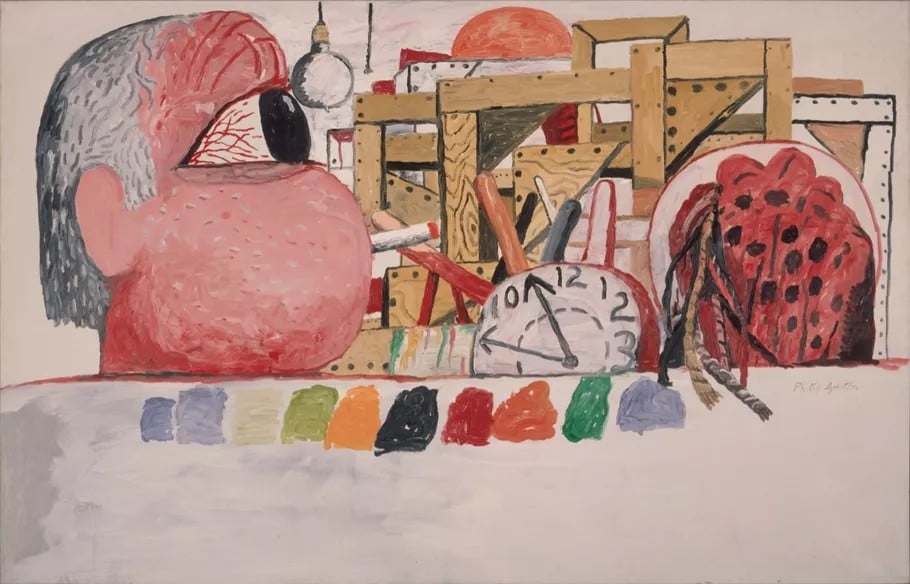
Philip Guston, Studio Landscape, 1975
Inspired by the Ultra Red workbook, we decided to write protocols for listening. We aimed to create protocols with a written output, with the intention of exchanging protocols for our writing exercise the next week. This proved difficult, as it was challenging to create a writing protocol that was oriented towards the act of listening, rather than memory or content.
My most successful protocol did not involve writing, but could attune students towards deep listening. I suggest that students sit in a circle with their eyes covered. They should create a story communally, with each participant offering a few words at a time. Participation should not be organized circularly, meaning that students should not speak if someone to their left or right has just spoken. There is no limit to the amount of words a student can contribute, but they are encouraged to say more than one. This exercise would require attention to the content of the story and attunement to their peers. They would listen for the breaths one takes before they speak, the location of the speaker and the sound of their peer’s thoughts winding down.
During our discussion, I became suspicious that the difficulty to differentiate between listening and content may originate in classrooms. We proposed that the sound of children playing is a unique object in itself, that the construction of a sonic landscape is a part of play. We then considered how schools, which teach children to organize themselves spatially (at desks) and socially (in a school community), also organize children sonically. In the classroom, students learn to take turns speaking, remain silent for long periods, and speak when directed to. Funnily enough, this organization of the sonic landscape is intended to encourage listening. And when a student deviates from this sonic organization, they’re accused of failing to “listen”.