|
Form of Analogy |
Term |
Characteristics |
Law |
|---|---|---|---|
|
Common/Inorganic |
Mold/molding |
Simultude. Permanent |
Crystalline. Surface. |
|
Organic |
Module/modeling |
Internal relation. Buffon |
Organic. Internal mold. Intermediate. |
|
Aesthetic/Royal |
Modulation/in-itself |
Resemblance via non-resembling means. Continuous. |
Energetic or Aesthetic. Pure modulation. |
Deleuze's On Painting: Session 5 - Analogy, Signal-Spaces, and Modulation (Also Egypt)
If, in Session 4 of On Painting, Deleuze proposes painting as the analogical language par excellence, Session 5 continues to examine the analog in its own terms, distinct from Code. If code articulates, the analog modulates. So what's modulation?
Here Deleuze wants to distinguish a range of possible forms of modulation, in particular to shake analogy free from mere similitude, while also maintaining they all fall within the sphere of analog/modulation. This takes a number of twists, but he is essentially proposing three forms, each associated with a loose set of terms, operations, figures, and laws. So let's just graph it.
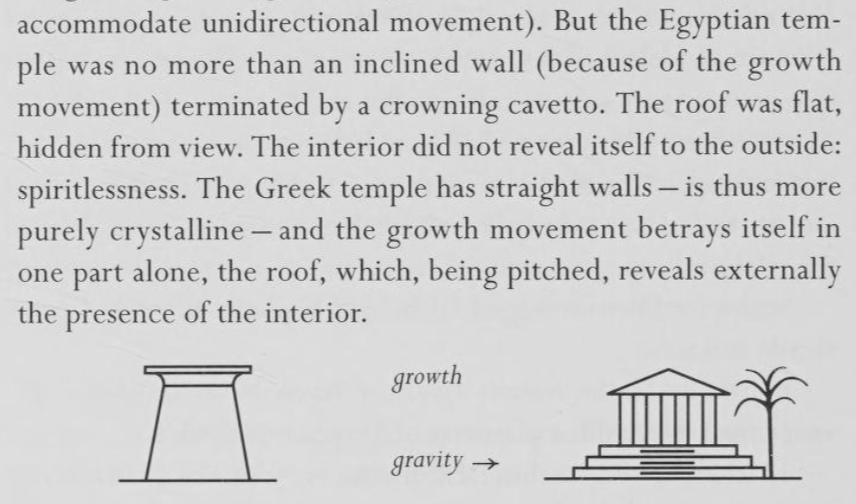
Thus, we see varying participation in the state of modulation itself via temporality. Deleuze borrows this from Simondon: to mold is to modulate permanently, while to modulate is to mold continuously. And we are also starting to see premonitions of Aloïs Riegl's use of the crystalline (see the image above, from Historical Grammar of the Visual Arts).
So where does this get us? If painting is analog, now we can begin to distinguish painting not just in terms of degrees of code and scopes of diagrammatic catastrophe, but in terms of its analogic form itself. And what is painting modulating, as a carrier?
The signal is space. A painter paints nothing but space—and maybe time as wee, space-time. What space? Perhaps the grand styles of painting differ according to—and at the same time as—the nature of their space-times.
So this is the next question: how do we distinguish paintings, via their mode of modulating space-time? What is the nature of signal-spaces? For this, Deleuze will turn to Riegl, and in particular his analysis of Egyptian art or Egyptian space. Riegl argues that art is not defined by what it can do but by what it wants to do: Riegl's Kunstwollen, or the will of art. What Egyptian art wants is what the Greeks claim to want, but get carried away by the organic: to extract eternal essence. The Egyptian artist achieves this via a flattening of volume and a surface-level transcription. The individual is essentialized by separating it from its ground via a contour—but in which all three are flat to each other! Flatness is the law of eternity. And we can see this, not just in painting, but in bas-relief (its essential form), the pyramid as a flattening of cubic volume, the creased folds of Egyptian clothing, and even in their houses and decorative motifs.
We also get a fascinating analysis of halos, but largely via the detour of exploring Bacon as something like the quintessential modern Egyptian painter.
A halo is a certain state of a thing that begins with Egypt, namely, the contour that's independent of form. [...] It's as if, in this age of athiesm, the halo for Bacon serves to encircle a foot, an unbearable insult to any pious soul...
What makes Bacon a modern painter, however, is that he takes his Egyptian separation of figure, ground, and contour, and drives it to a new desire: to modulate color. And indeed, next time, he will return to the Egyptian signal-space via a lengthy detour though Goethe's color theory...