Deleuze's On Painting: Seminar 4(b) - The Analog
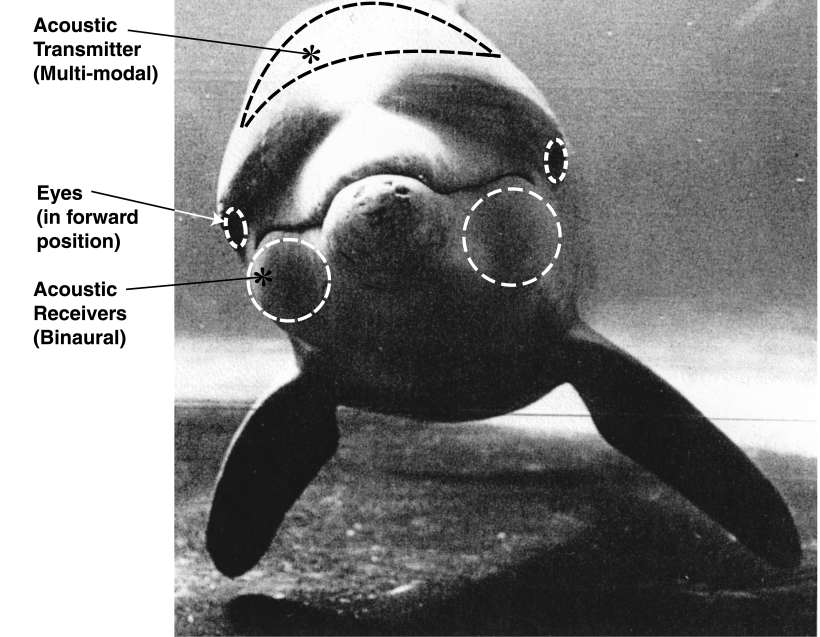
I sort of get the feeling that an abstract painter is no different from a dolphin. They’re dolpins; they’re painter-dolphins.
—Deleuze, On Painting, 133.
In the second half of session 4 of On Painting, Deleuze switches things up. Up until now he has been considering the role of code in Abstract Art. And he does so by an elaboration of the manual, distinguishing the hands different possible arrangements and relationships to the eye. So we get the digital—tactile—manual that we discussed previously [link]. But what he want to carrry forward from this, is the way in which the digital hand selects amongst binary, articulated relations. (We should recall that even the proliferation of the color wheel or of phonetic language is, for Deleuze, grouped via binaries: complementary colors, or “distinctive features” such as the V/D phoneme relationship. These non-hand binaries will become important.)
So far, so good. But then he proposes a long detour: “I’d like to get to the point where we can propose a definition of painting.” And he wants to know, “Is painting a language, or is it not a language?” But more precisely, “Is painting an analogical language? Is painting theanalogical language par excellence?”
What makes this a detour? It’s not that he is about to flip code around to consider it’s opposite. Because code is already a strange detour for painting. It almost seems like he is saying that in order to define painting we have to understand its opposite (code), and then by analogy(!) look for the equivalent in painting. And he is going to do that, not through painting, but through linguistics! And so all of a sudden, the manual drops out in all its forms, and he introduces two strange examples of coded language that somehow point to a non-coded language: dolphins and “the northern man.” Bateson and Rousseau. (And, interestingly, should we consider a connection between the linguistic utterances of the northern man and the mechanical or in-organic Gothic or “northern line” of Worringer?)
So what is going on here? Why the detour to the ocean and the north? From hand to snout? All we can say, for now, is that in posing the question of the definition of painting, he has linked it to the question of language and to the analog. And so he is working hard to decouple the diagram of painting from the trap of similtude, where it has endured through Pierce and the Americans. And for this he splits analogy into its two evident functions: it can re-produce a resemblance, or you can produce relations. Photography or painting. Common analogy or analog synth. “Painting produces resemblance through non-resembling means” (128). So it does something different, but it is still caught up in the question of resemblance.
And this is where Deleuze turns to Bateson and his dolphins. And he says something interesting that’s easy to miss. In an apparent aside on Bateson’s career, and how he got tons of funding from the U.S. military but to hilariously non-productive results, Deleuze says, “you’ll definitely see why I’m going through his career.” So he wants to say that this is the point: the more you try to code dolphins for (military) significance, the more you find that the dolphin eludes capture. the more you look for similtude in painting the more you find something else. So what is this something else? It’s the μ-function, or the “meow” function. Which is to say, when your can meows at you, “they aren’t saying milk, milk; they’re saying Dependency! Dependency!, I depend on you…” (131). Analog language is a language of dependent relations.
So why not stay with cats? Because cats are domesticated and domesticating, and they don’t subvert the war-machine? Where’s the catastrophe? The cat-astrophe?! I’m sure we could find one. Dolphins on the other hand, clearly know catastrophe. From fish, to land animal, and back to the ocean, the dolphin is the product of catastrophe. And according to Bateson, this is the only occassion why you would want to encode the μ-function, grafting code onto analogy. Why? Because unlike fish, their analogic language is now like a fish out of water. (Like an even-toed ungulate in water?!) They lose their new expressive face and voice, as well as the head/body distinction, and find themselves communicating in a murky fluid depth. (Side quest: dolphins belong to the toothed whale family, and their language is almost an inverse of whale-song, so what were the distinct evolutionary adaptations that went on here?! A trade off between short-range sonar and long-range territory?) But in any case, this is the joke on the military: for all of the dolphin’s articulations of code, they are just using it as a carrier matrix for analog μ-functions. (Although they do, apparently, have names.)
Fair enough, but what exactly is this code grafting onto? What’s the painting of the voice? This is where Rousseau’s man of the north comes in. Language, for Rousseau, is articulated. But only after a catastrophe. When southern man wandered north they suffered the articulation of the industrial.And in the process all of language’s fundamental intonations were lost to accents. The melodic gave way to harmony. Sounds bifurcated into articulation and noise. But… beneath all of this, we uncover something truly analog: modulation.
And so here we have to be willing to cross species, or cross organs. The binary is not just a function of the hand, it is achieved by the dolphin and by the northern mouth. But nor is it the same. There is a catastrophe and relation inherent to the distribution of organs. The manual is the hand running off from the eye. But the hand and mouth, we know from Leroi-Gourhan, co-determine each other as the poles of gesture and speech (that can be coordinated, via the eye, in two distinct fashions: the mythogram or writing, the analog or the digital!) Neither the code nor modulation are specific to an organ, but work across organs and across species. Which is what would allow us, via this detour, to return to painting via a non-common analogy, a synthetic analogy: