Deleuze's On Painting: Seminar 3(b) - The Risks of Painting
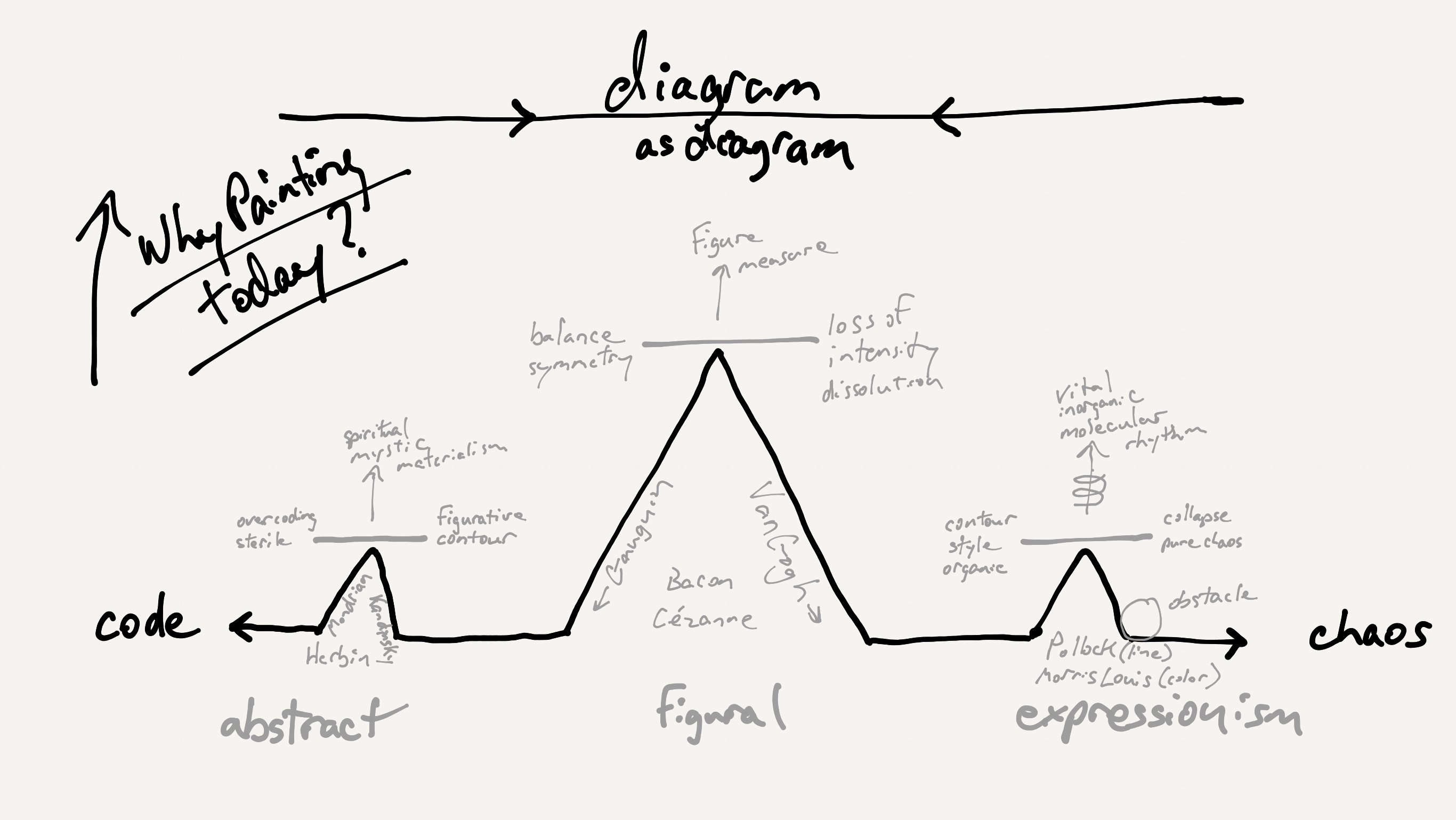
Deleuze continues to circle around the diagram, and in the second half of Seminar 3 of On Painting, he uses the diagram as a way to articulate three positions for answering the question of "why paint today?", each with its own risks. In particular, we see a strategy of pushing the diagram to its two extremes: code and chaos, linked to Abstraction and Expressionism. And then a no-less fraught middle way of the Figural.
In the context of Pollock, Deleuze will briefly bring up fractals as a kind of mathematical equivalent of the painterly attempt to free the line from either one or two dimensions. This is also what he'll continue to refer to as the Northern Line, or we could think of in terms of Klee's medial line. But perhaps this also gives us a way of thinking about the diagrammatic positions themselves. At the extremes, it's easy enough to imagine a kind of diagrammatic line that, pushed to its limit, runs the risk of too much or too little, overcoding or pure chaos. But then it seems like the third pole of the Figural is not a pole at all, but safely and temperately in the middle, which is not the case.
So perhaps we can think of a fractal line as a kind of diagram of the positions in relationship to the diagram itself. A certain kind of exta-dimensional intensity can emerge anywhere along the line, generating new potentials that might speak to the question of why painting today, but also a specific set of risks for trying. This allows us to think beyond just the clear risk of each position. Of course, the risk of abstract expressionism is that it pushes too far and collapses into chaos. However, if it doesn't push up against some obstacle, it also runs the risk of falling back into a contour and a kind of clichéd style. (Interestingly, one of the ways in which authentic Pollocks have been determined is through fractal analysis. A "fake" Pollock isn't sufficiently fractal, as a kind of vital limit that only Pollock could approach, they say.)
And this also allows us to see that Figural painting also has its local risks and intensities. It's not just that the Figural can easily fall back into the figurative and representation, but that it can lose its intensity either through a local dissolution into chaos or through an overly balanced symmetry. But this also means we can locate even more specific fractals. As Deleuze points out, Van Gogh flirts with "an Expressionist adventure," and Gauguin is a precursor of abstract painting.
This leaves us with a larger question of how this expresses historically, and whether these are always in some sense local, historical battles. But it also leaves us with similar questions around Deleuze's concept of the manual, not as simply a matter of the hand, but of a certain tactile, kinesthetic troubling of the eye as a kind of suppression of... what?... the diagram? Chaos?
In any case, we continue to find a provocative resonance with one of Open Practices' recurring motifs: gesture. And we should perhaps keep in mind that Deleuze will elsewhere draw on Leroi-Gourhan's Gesture and Speech, but perhaps not without risk.