Deleuze's On Painting: Seminar 3(a) - Characteristics of the Diagram
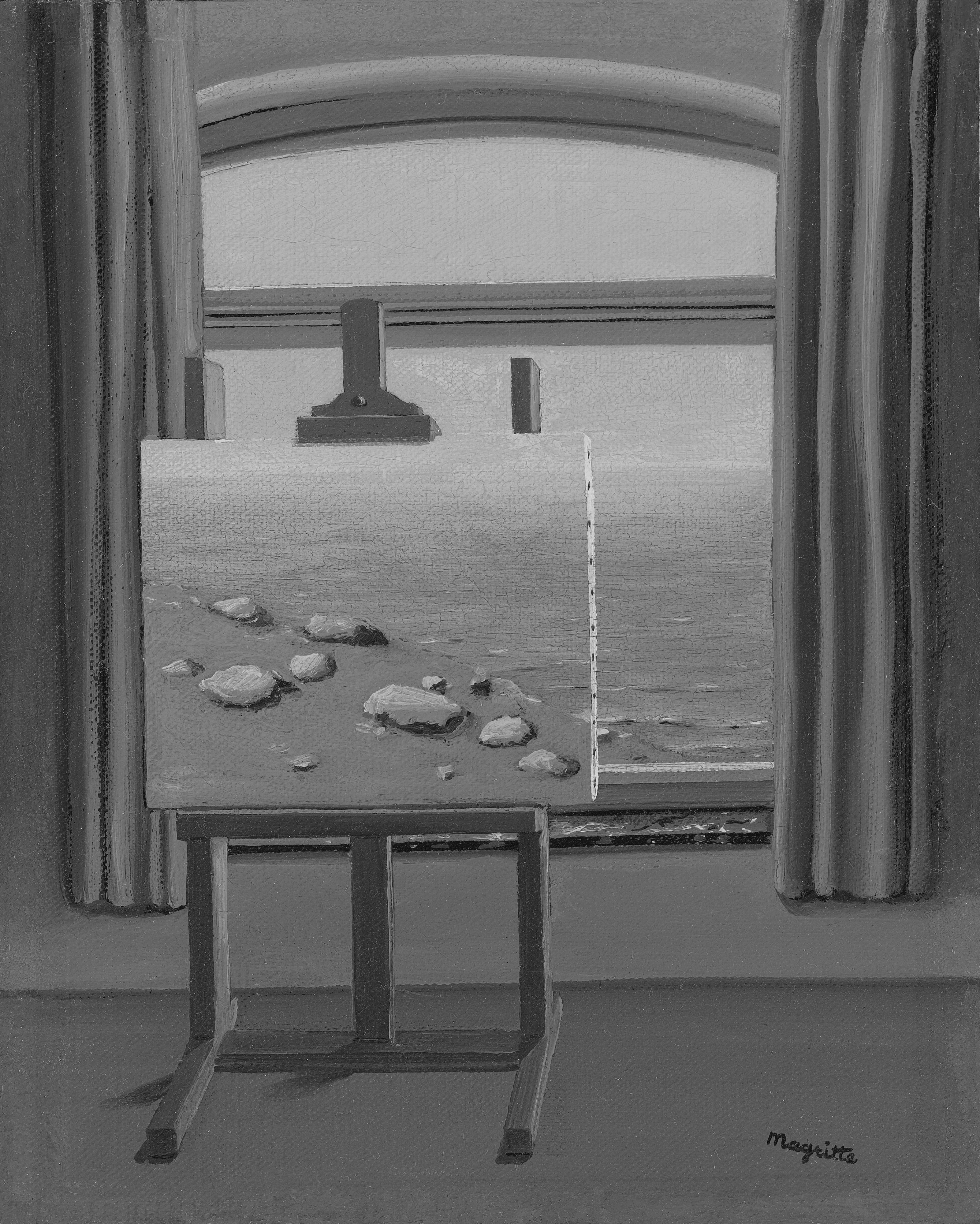
The Human Condition, Magritte, 1933.
In Seminar 3 of Deleuze's lectures on painting, he cycles back through the catastrophe as laid out and repeated in the first two seminars, this time pulling out five characteristics and risks of what he is now calling "the diagram." The risks will have to wait until next time. For now, we should just note the sort of sliding terrain. Each time he takes another pass at painting, he adds more layers and variations of language as well as diving into more specific elements, but also seems to be redrawing or reworking the landscape as he goes.
With Seminar 3, the scope is now being determined by the concept of the Diagram, and he continues to clean it up into a three part synthesis of time: the pre-pictorial, the act of painting, and the pictorial fact (or any number of re-phrasings.) Significantly, however, the first characteristic of the diagram in now the germinal chaos. And what before was split between germinal chaos and the catastrophe—where Bacon names the diagram—appears now to be lumped together. (Open question: do we lose the question of how the act of painting holds open and extends the germinal chaos into a new problem?)
We lose sight, for now at least, of this doubling of both the catastrophe and of emergence—something has to emerge from the chaos to start painting, but then painting has to suffer its own catastrophe out of which a pictorial force fact. And the questions of cliché and of force, with which seminar two is bookended, also seem to recede.
But we gain two new elements. In recapitulating the terrain and drawing out characteristics, Deleuze now seems to slide a new dimension in that wasn't at all explicit before: the notion of the "manual." This occupies the largest part of the enumeration of the characteristics. And it should be noted that he actually suggests, although it is named after the germinal chaos, that it explains the how of germinal chaos.
Notice that this second characteristic is an extension of the first because I can explain how there is chaos here. ...it's easy to see why the diagram is chaotic, since, once again it entails the breakdown of visual coordinates, courtesy of the act liberating the hand. (78)
This is perhaps one of the reasons why we should continue to remember that he is collapsing the chaos-germ and catastrophe into a single diagrammatic chaos. But it suggests that it is not just because the hand begins to rework the visual in the act of painting that we get chaos, but that the unfettering of the hand from the eye is already at work in creating the pre-pictorial conditions for the act of painting itself.
What remains to be seen is how we are to think this question of a tension that emerges within these aspects of the body and world. What exactly is a "hand," and what exactly is an eye, never mind a third-eye? For now, we only have the beginnings of a series of distinctions and problems. The first, between the idea of the stroke-patch and the line-color. And the second, the distinction between a door-window and a window (sans door), which—drawing on Virilio—suggests a fundamentally different relationship between the movements of a body and its coordination in space. This is also framed, so to speak, as the painterly problem of edges, and of the easel, or the easel-brush. All of this organizing around what Virilio identifies as "the first major abstraction that might be called anthropocosmic, namely, the isolation of light." (74)
Has this always been the, or at least a, struggle of art? Or is painting tasked with overcoming the array of apparatuses that couple with the window to exclude the body as a specific historical challenge?